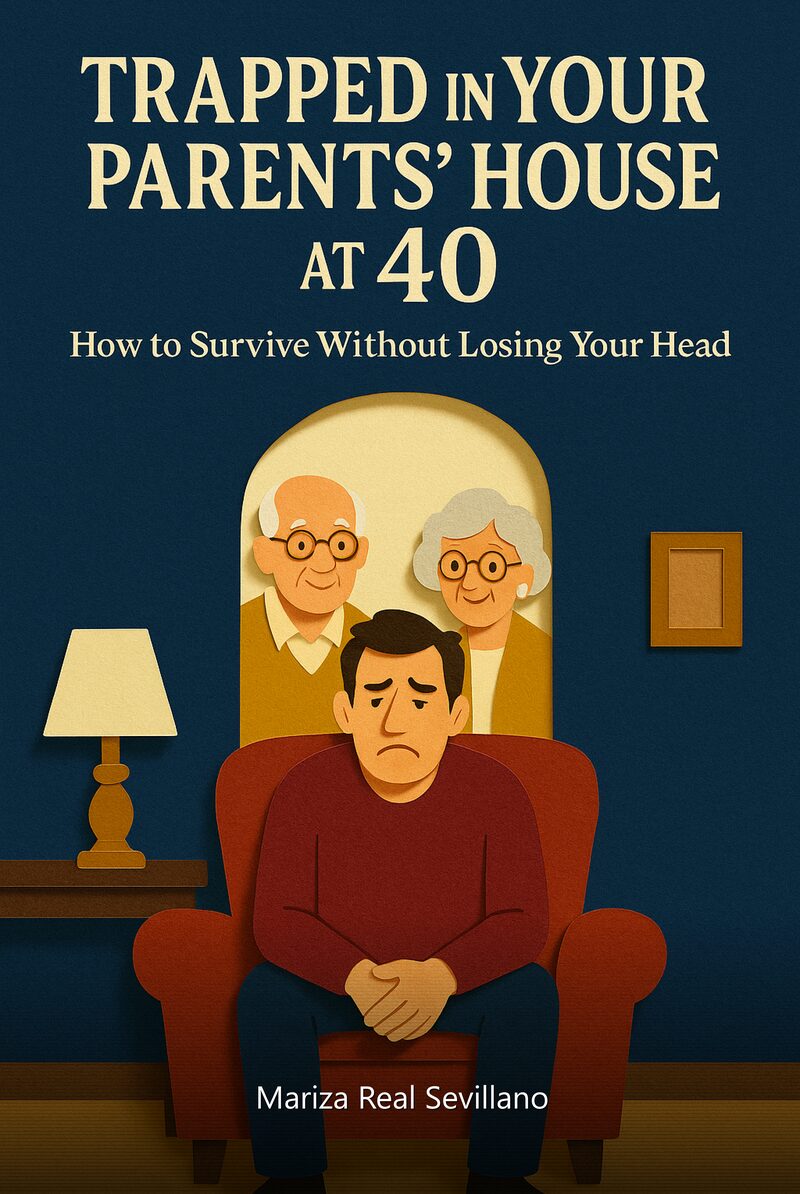
Trapped in your parents' house at 40
How to Survive Without Losing Your Head
Where to get it
Audiobook · 3 h 22 min · Synthetic (AI) voice · How we make our books
Prices checked in the stores on 25 Oct 2026; they may change.
- Published
- Language
- English
- Formats
- Ebook · Audiobook
- Category
- Autoayuda
For general information only: not a substitute for help from a mental health professional. How we make our books
Spotted a typo or have a question about this book? Write to us
Synopsis
Read the beginning
From the chapter «Introduction: The reality of coming home»
Introduction: The Reality of Moving Back Home
Moving back in with your parents after forty is not the end of your adult story. It is simply a circumstance that thousands of people are going through right now. Perhaps you have been hit by a layoff, a separation, the impossible cost of keeping a rental, or a combination of all of the above. Whatever the reason, the result is the same: you find yourself once again between the same walls you left years ago, with the feeling that time has gone backward without your permission.
This situation does not define your worth or your capacity. However, it does demand a new way of relating to your family, to yourself, and to your future. The goal of this book is precisely that: to give you practical tools so that living together does not set you back emotionally, but instead allows you to move forward with greater clarity and autonomy.
For decades we were sold the idea that adult life followed a linear path: independence, partnership, own home, stability. That narrative has broken for many people. The data show that the number of adults between 35 and 50 who live with their parents has grown steadily over the last fifteen years. This is not a small group or a temporary phenomenon. It is a structural trend linked to the labor market, housing, and changes in family structures.
When this happens, what is most common is not the lack of resources but the lack of honest conversation about how to manage the new dynamic. Many people settle into an uncomfortable silence, hoping that “this will only last a few months.” The months turn into years and tension grows without anyone knowing exactly how to name it.
One of the first emotions that appears is shame. You wonder what people will think, what your friends will say, or how you will explain your situation in a meeting. That shame, though silent, consumes an enormous amount of energy. It makes you avoid calls, cancel plans, or minimize your own life in front of others. […]