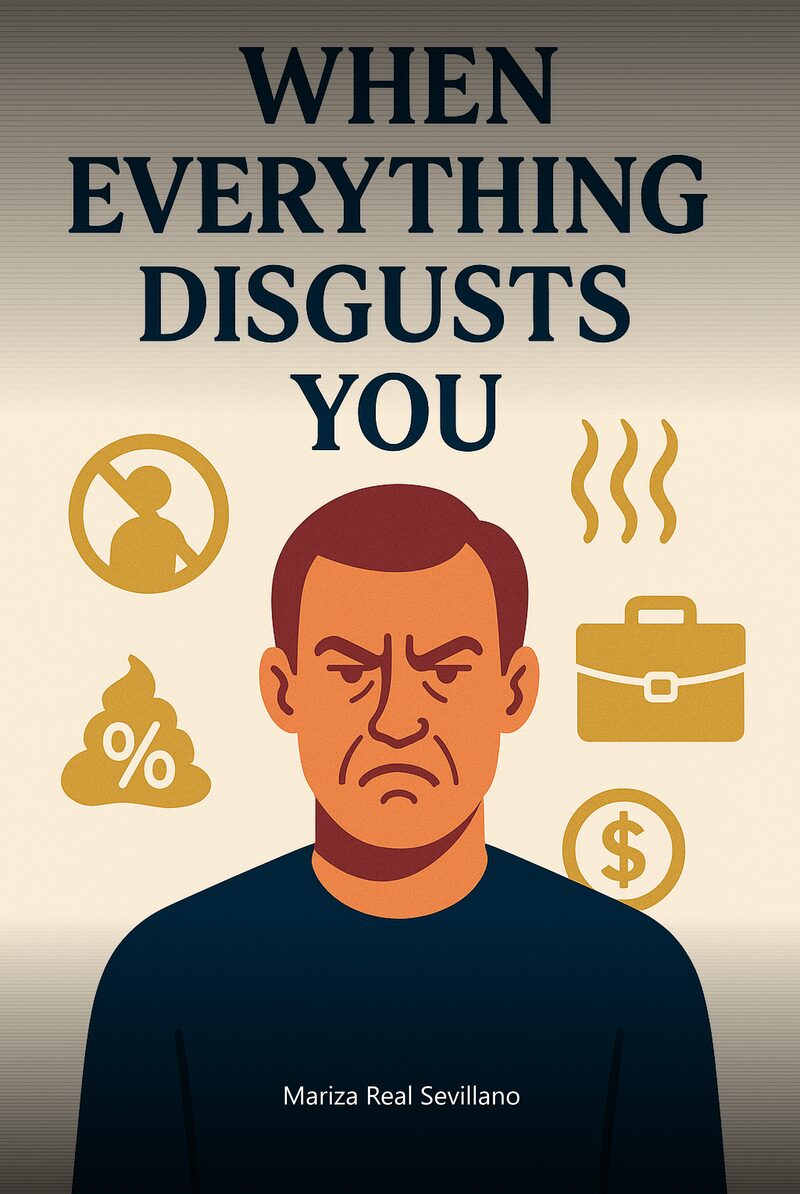
When Everything Disgusts You
Where to get it
Prices checked in the stores on 25 Oct 2026; they may change.
- Published
- Language
- English
- Formats
- Ebook
- Category
- Autoayuda
For general information only: not a substitute for help from a mental health professional. How we make our books
Spotted a typo or have a question about this book? Write to us
Synopsis
Read the beginning
From the chapter «Introduction: Disgust as a Starting Point»
Disgust does not arrive all at once. It settles in gradually. It is that feeling that appears when a conversation leaves you empty, when a family gathering drains you completely, or when, simply, you prefer to stay home rather than go out and pretend everything is fine. If you are reading these pages, you have probably already felt that wave of rejection toward human interactions. You are not broken. You are tired.
This book starts from a simple premise: disgust can become your greatest ally if you learn to listen to it instead of fighting it or, worse still, ignoring it.
Many people who describe themselves as misanthropes have reached that conclusion after years of disappointments. It is not that they hate humanity in the abstract; it is that they have accumulated too many experiences in which they were hurt, manipulated, or simply exhausted. Disgust then functions as an internal alarm system. It warns you when something (or someone) threatens your energy.
The problem arises when that same disgust becomes the only response. You stop distinguishing between what truly harms you and what merely makes you uncomfortable. Isolation becomes the default solution. And while it protects you in the short term, in the long term it leaves you alone with your thoughts, without the possibility of building relationships that truly nourish you.
That is why the first step is not “to stop feeling disgust.” It is to understand what it is telling you.
Disgust toward people usually has concrete origins:
Wounds of trust: relationships in which you were vulnerable and were betrayed. Sensory and emotional overload: environments where you had to maintain a constant mask. Conflicting values: living with people whose actions clash directly with what you consider important. Lack of clear boundaries: having allowed others for years to invade your space without consequences.
Recognizing these roots does not justify total isolation, but it does explain why your protection system activated so strongly. Disgust is not irrational; it is information.
Disgust becomes destructive when we use it to judge everyone equally. […]