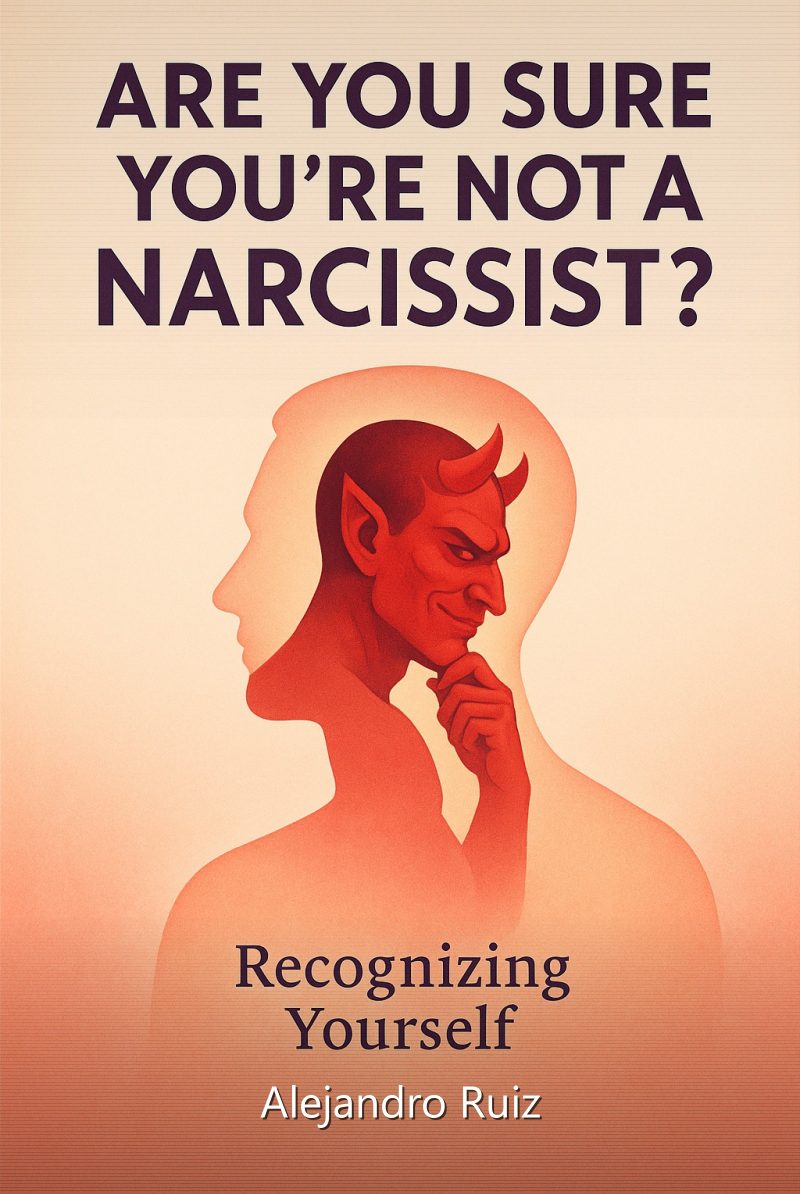
Synopsis
Table of contents
- Introduction
- Chapter 1: Understanding Narcissism
- Chapter 2: Are You a Narcissist?
- Chapter 3: Impact on Relationships
- Chapter 4: Recognizing Your Patterns
- Chapter 5: Healthy Confidence
- Chapter 6: The Path to Change
- Chapter 7: Empathy and Connection
- Chapter 8: Assertive Communication
- Chapter 9: Overcoming the Fear of Change
- Chapter 10: The Importance of Forgiveness
- Chapter 11: The Connection with Others
- Chapter 12: The Power of Reflection
- Chapter 13: Maintaining Progress
- Chapter 14: Celebrating Your Growth
- Conclusion
Ver todos los apartados
- Introduction
- Why This Book?
- Narcissism in Everyday Life
- Chapter 1: Understanding Narcissism
- Characteristics of Narcissism
- Subtle Narcissism vs. Evident Narcissism
- Chapter 2: Are You a Narcissist?
- Personal Reflections
- Self-Assessment Test
- Chapter 3: Impact on Relationships
- Effects on Family and Friendship
- Narcissism in Romantic Relationships
- Chapter 4: Recognizing Your Patterns
- Communication Patterns
- Isolation Behaviors
- Chapter 5: Healthy Confidence
- Building Self-Confidence
- Avoiding Selfishness
- Chapter 6: The Path to Change
- Establishing Clear Objectives
- Commitment and Action
- Chapter 7: Empathy and Connection
- The importance of empathy
- Practical Exercises
- Chapter 8: Assertive Communication
- Principles of Assertive Communication
- Practices and examples
- Chapter 9: Overcoming the Fear of Change
- Identifying Your Fears
- Strategies to Overcome Them
- Chapter 10: The Importance of Forgiveness
- Forgiving Yourself
- Forgiveness in Relationships
- Chapter 11: The Connection with Others
- Creating Meaningful Relationships
- Vulnerability as Strength
- Chapter 12: The Power of Reflection
- Daily Reflection Practices
- Learning from past experiences
- Chapter 13: Maintaining Progress
- Maintenance Strategies
- The Importance of the Community
- Chapter 14: Celebrating Your Growth
- Personal Celebrations
- Sharing Your Story
- Conclusion
- The journey never ends
- Additional Resources
Read the beginning
From the chapter «Introduction»
Most people assume that narcissism is a trait that belongs to others—something they observe in other people but never in themselves. That certainty usually remains intact until relationships begin to fail repeatedly or until a persistent feeling of dissatisfaction arises that cannot be explained by stress or external circumstances alone.
This book starts from a direct question: what if some of the patterns you point out in others were also operating in you? It is not about accusing you or labeling you, but about opening the possibility of seeing yourself more clearly. Subtle narcissism does not always appear as obvious grandiosity; it often shows up in smaller, socially accepted forms: the need to be right, the difficulty of admitting mistakes without adding justifications, or the tendency to measure a relationship’s value by how much admiration it provides.
Many behaviors we consider normal in daily life contain a dose of narcissism we rarely question. Think of those conversations where, even as you listen, you are really just waiting for your turn to share your own version or correct the other person. Or consider how you react when someone offers constructive criticism: do you take it as useful information or as an attack that must be neutralized?
These patterns do not make anyone a “narcissist” in the clinical sense, but they can erode the quality of relationships and personal well-being. When the focus is on protecting the image you have of yourself, it becomes harder to sustain honest connections. People close to you sense that rigidity and, over time, they pull away or stop sharing what they truly think.
Most significant changes in life begin when we stop looking for explanations outside ourselves. As long as you keep attributing problems in your relationships to other people’s lack of empathy, you remain without control over what you can actually change. When you recognize your own part in those patterns—even if it is small—you regain agency.
This does not mean everything is your fault. […]