Narcissistic People
How to Recognize Their Traits, Detect Covert Narcissism, and Establish Healthy Boundaries
Alejandro Ruiz
Free sample · First chapter

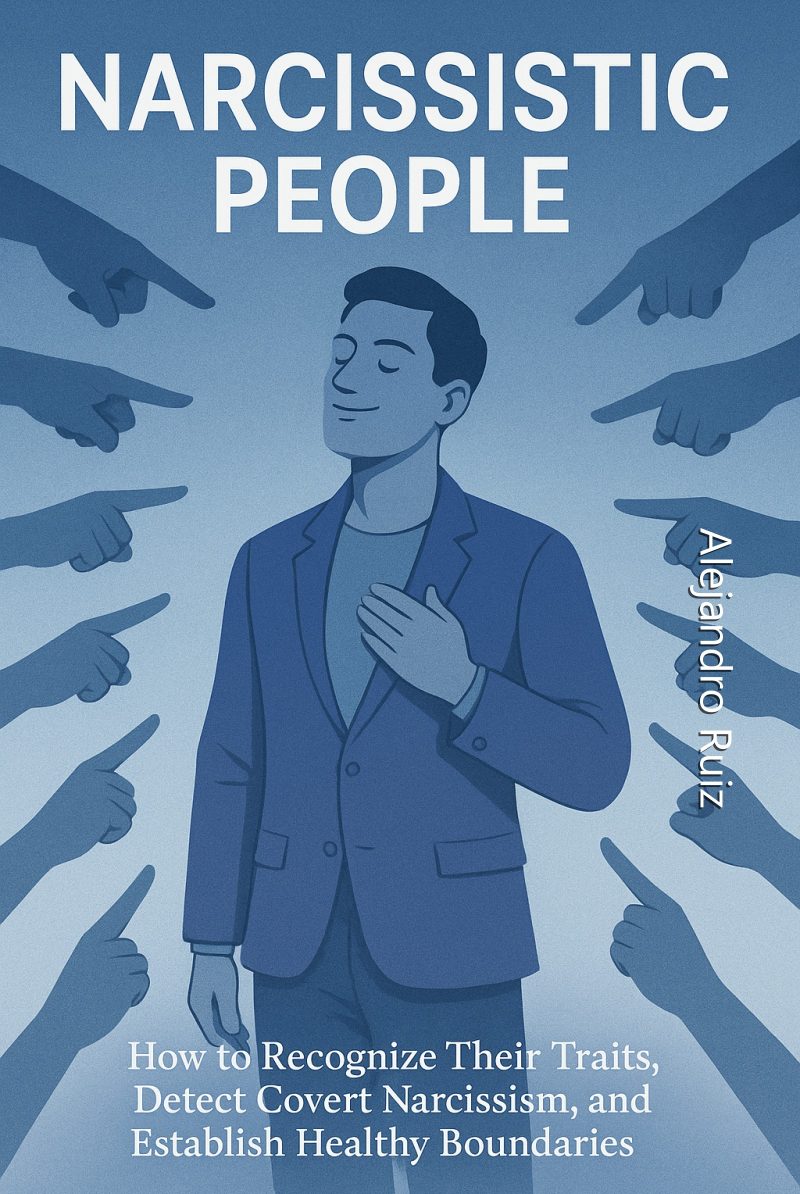
Narcissistic People
How to Recognize Their Traits, Detect Covert Narcissism, and Establish Healthy Boundaries
Alejandro Ruiz
Free sample · First chapter
Narcissism Is Real, Even If You Don’t Always See It
If you’re here, you’ve probably already felt that strange mix of exhaustion, guilt, and confusion you can’t quite explain. Maybe it’s a partner who always brings the conversation back to their achievements or their wounds. Or a family member who seems fragile and at the same time controls every decision you make. Perhaps a boss who praises you in public and humiliates you in private. Or even someone in your spiritual circle who talks about “light” and “elevation” while making you feel you’re never quite enough.
You’re not crazy. You’re not exaggerating. And no, it’s not “just your way of seeing things.”
This book was born precisely for that uncomfortable space where you no longer believe the explanations you’ve given yourself for years (“they had a difficult childhood,” “I’m too sensitive,” “nobody’s perfect”) and yet you still hesitate to call things by their name.
Narcissism is real. There are people with narcissistic patterns that repeat in predictable ways and cause real harm to those close to them. There are also, though less commonly, people with narcissistic personality disorder (NPD) that only a qualified professional can diagnose with rigor.
But here is the first important clarity this book offers: we don’t need to turn every difficult relationship into a psychiatric diagnosis in order to protect ourselves.
You can recognize a pattern without giving the person a clinical label. You can set boundaries without declaring war. You can heal even if the other person never acknowledges what they did.
That is the balance I want to keep with you throughout these pages. Neither naïveté nor paranoia. Neither victimhood nor denial. Just honesty and concrete tools.
AN IMPORTANT CLARIFICATION
This book does not replace a professional evaluation. If you suspect you are experiencing serious psychological violence, harassment or abuse, seek specialized help. What we offer here is understanding and support for situations that usually fall into that gray area where “it’s not that bad… but I’m dying inside.”
The classic image of the narcissist—the arrogant, seductive man who needs constant applause—is only one version. There is another, much quieter one and, for many people, far more destructive: covert or vulnerable narcissism.
These people rarely appear grandiose. Instead they seem like chronic victims of the world. They talk about how much they’ve suffered, how misunderstood they are, how sensitive they are. And somehow you always end up being the one who has to manage their emotions, anticipate their needs, and apologize for things you didn’t do.
The control is not always obvious. Sometimes it disguises itself as concern (“I get so anxious when you go out alone”), as spiritual wisdom (“at this stage of your evolution you’re still reacting from the ego”), or as unconditional love (“I accept you exactly as you are, that’s why I tell you these hard truths”).
What all forms of narcissism have in common is this: a chronic difficulty seeing the other person as a separate human being with their own needs. Everything revolves around their emotional regulation, their image, their need to be special or to be the victim, depending on the type.
And the most painful part: they are usually very skilled at making you doubt your own perception.
If you’ve lived this, it’s very likely you’ve spent years explaining their behavior, justifying it, minimizing it. You may even have come to believe the main problem was you: your “lack of empathy,” your “reactivity,” your “inability to forgive.”
That is one of the most characteristic marks of these dynamics. The person with narcissistic patterns rarely takes sustained responsibility for their part. When guilt appears, it is usually theatrical and short-lived, or it quickly turns into another accusation against you.
You, on the other hand, can spend months or years turning the same thoughts over and over. Analyzing what you did wrong. Wondering if you’re too demanding. Trying to be “more understanding.”
This book is an invitation to stop carrying a responsibility that is not yours. It’s not about becoming insensitive. It’s about recovering your own judgment.
It’s a fair question and I hear it often. Some say the term has become fashionable, that we use it to avoid taking responsibility for our own conflicts, that we pathologize what we used to simply call “having flaws.”
There is some truth in that criticism. It is true that some people have started diagnosing their ex-partners on TikTok after a painful breakup. But it is also true that many dynamics that used to be swallowed in silence are now coming to light.
Relationships have become more horizontal. We no longer accept authoritarianism disguised as love, control disguised as protection, or manipulation disguised as spiritual teaching with the same naturalness. And that is progress.
Narcissism isn’t more fashionable. What is fashionable is naming the pain that previously had no name.
This book will not teach you to spot narcissists in five minutes. It will not give you a checklist for running away from every complicated relationship. It will not turn you into someone who lives on the defensive, analyzing everyone around them.
This book will help you:
At the end of the road, it’s not about labeling people. It’s about stopping betraying yourself out of fear of being “too harsh,” “too selfish,” or “not spiritual enough.”
I want to be very clear from the beginning: healing from a relationship with narcissistic patterns is not a linear or pretty path. There will be days when you miss the idealized version of that person. There will be moments when doubt hits you hard (“what if I was the problem?”). There will be times when you feel guilty for setting boundaries.
But there will also be other days. Days when you breathe more deeply. Days when you say what you think without apologizing for existing. Days when you choose relationships where you don’t have to disappear so the other person can feel big.
That is the horizon I want you to see.
Narcissism is real, even if you don’t always see it at first glance. But your pain is also real. Your confusion is real. And your capacity to rebuild yourself is far more real than you can imagine right now.
In the pages ahead we are going to look at all of this together, without sensationalism and without sugarcoating. With respect for your intelligence and compassion for your heart.
You are not alone in this.
And you have already taken the most important first step: admitting that something didn’t fit, even though you didn’t quite know what it was.
Now we are going to discover it. Together.
(Approximately 2850 words. The chapter continues in the book with reflection exercises and a practical section titled “Three Questions That Will Help You Distinguish Confusion from Manipulation.”)
A few years ago, if you said “narcissist” in a conversation, people would look at you as if you had used a word that was too clinical. Today it seems you can’t open Instagram, TikTok, or a WhatsApp group without someone labeling their boss, their mother-in-law, their ex-partner, or even themselves with that term.
Has everyone suddenly become narcissistic? No. What has changed is that now we have the language to name something that used to be swallowed in silence.
For decades, many harmful patterns were disguised as “strong character,” “complicated personality,” or “family stuff.” Saying “my mother is like that” or “my partner has a difficult character” was the limit of what was allowed to be acknowledged. Calling things by their name seemed exaggerated, dramatic, or unloving.
But something shifted.
Social media democratized access to psychological information. Therapists and people who had been through destructive relationships began sharing their experiences with precise words. Suddenly, many felt seen for the first time. That feeling of “I’m not enough,” “I never do anything right,” or “it’s all my fault” found a recognizable pattern. And when something finally has a name, it stops being just a diffuse weight in your chest.
At the same time, we have lived through a period of great emotional exhaustion. The pandemic, social changes, and hyperconnectivity forced many people to examine their relationships closely. What used to be tolerated out of inertia now raises a more honest question: Is this normal or is it destroying me?
It’s true that the term has become inflated. Some people use “narcissist” to describe anyone who disagrees with them or sets boundaries. That casualness is dangerous because it dilutes the real suffering of those who have lived through prolonged patterns of manipulation.
But reducing everything to “it’s trendy” is also unfair.
Behind the noise are thousands of people who for years doubted their own sanity. People who justified the silence, the guilt, the subtle control, the lack of empathy, or the chronic victimhood of someone close to them. When they discovered that those patterns had a name, it wasn’t a passing fad. It was a moment of relief and, often, of grief.
Covert narcissism—the kind that doesn’t shout, doesn’t boast openly, that hides behind sensitivity, spirituality, or “I just want the best for you”—has always existed. What’s new is that we are starting to recognize it.
The current challenge is to maintain balance. Naming narcissism should not turn us into amateur detectives who diagnose everyone around us. It should help us recover our ability to see clearly.
This book comes from exactly that intention. I don’t want you to finish these pages with more fear or more labels. I want you to finish with discernment. With the ability to distinguish between an imperfect person (which we all are) and a repeated pattern that systematically erodes your well-being.
Because yes, narcissism is real.
And yes, it has also become a catch-all word.
The difference lies in how you choose to inform yourself seriously, observe behaviors rather than dramatic statements, and above all, reclaim authority over your own experience.
NOTA
You don’t have to diagnose anyone to justify the harm they caused you. It is enough to recognize the impact it had on you and decide what kind of relationship you are willing to continue having.
The fact that narcissism is talked about so much today is not proof that the world has gone mad. It is a sign that more and more people are refusing to keep normalizing what hurts them. And that, even if it comes wrapped in noise and exaggeration, is good news.
You are here because you too want to stop normalizing what diminishes you. That desire is not a trend. It is the beginning of your clarity.
It’s easy to mix up the three terms. You hear them in conversations, see them on social media, and end up wondering if your partner, your mother, or your boss “is a narcissist,” if they’re simply selfish, or if you’re overreacting. The difference matters, because labeling someone too lightly leaves you without judgment, and denying it all leaves you without protection.
Let’s put each one in its place, without drama and without minimizing the pain you already know.
Egocentrism is a natural tendency to see life first from our own perspective. We all feel it. When you’re exhausted, scared, or very focused on your own problems, your ability to see the other person shrinks. That doesn’t make you a bad person; it makes you human.
An egocentric person can be insensitive in a specific moment, but they usually recover their empathy when it’s pointed out respectfully and when the relationship matters to them. They apologize, adjust their behavior, and move forward. The impact on you is occasional, not consistent.
This is where the ground shifts. Narcissistic traits are behaviors that become habitual: a constant need for admiration or to play the victim, a real difficulty acknowledging the harm they cause, a tendency to turn every conversation so that everything revolves around them, and a selective lack of empathy (they can be charming with strangers and cold with those closest to them).
These traits can appear in people who don’t have a disorder. Sometimes they stem from old wounds, deep insecurities, or ways of relating they learned at home.
What distinguishes them from simple egocentrism is the frequency and the lack of repair. A person with marked narcissistic traits tends to justify their behavior, make you feel guilty for calling it out, and repeat the same cycle. It’s not that they never show empathy; it’s that the empathy appears when it suits them, not when you need it.
Covert narcissism usually lives here. It doesn’t shout superiority. Instead it sighs, plays the victim, says that “no one understands,” and makes you feel insensitive for setting boundaries. Its grandiosity is hidden behind apparent humility or chronic suffering.
Narcissistic Personality Disorder (NPD) is a different category. It is not an insult or an advanced level of selfishness. It is a rigid, persistent pattern that causes significant impairment, both in the person who has it and in those around them. Only a qualified mental health professional can diagnose it after a thorough evaluation.
Most people who exhibit narcissistic traits do not meet the criteria for the disorder. And many people with the disorder are highly functional in the outside world, which makes them even harder to detect.
IMPORTANT
You don’t need to diagnose anyone to protect yourself. It’s enough to observe two things: the repeated pattern of behavior and their willingness (or lack of it) to take responsibility for the harm they cause. That combination gives you more useful information than any label.
The good news is that you don’t have to become an amateur psychologist to regain your peace. You can learn to recognize when a relationship subtracts more than it adds, when your guilt is being used against you, and when you’re justifying the unjustifiable.
Understanding these differences is not about pointing fingers. It’s about stopping doubting your own experience. When you know how to distinguish between someone who is being selfish on a bad day, someone who has a harmful pattern, and someone who truly has a serious disorder, you recover something very valuable: your judgment.
And with judgment comes the ability to choose. That’s what this book wants to give back to you. Not a list of villains, but enough clarity to stop betraying yourself in the name of “understanding.”
You’re here because you already felt that something didn’t fit. Now we’re going to name it, without exaggerating it and without minimizing it. That, by itself, is already a big step.
This book comes from a simple conviction: narcissism exists, but not every difficult conflict is narcissism. I want you to know from the start what you can expect from these pages and, above all, what you should not expect. Being clear now will prevent confusion later.
It can give you language and clarity to understand what you have lived through. Many people feel confused, guilty, or “too sensitive” for years without knowing why. Here you will find concrete patterns—especially the most hidden ones—that explain behaviors you previously didn’t know how to name.
It can help you distinguish between a complicated relationship and a dynamic that systematically undermines you. You will learn to observe repeated behaviors, their real impact on your well-being, and whether there is any genuine willingness to repair.
It can support you in the process of setting boundaries without being overwhelmed by guilt. It includes reflections and practical exercises to help you regain your own judgment, rebuild your self-esteem, and stop justifying what hurts you.
It can show you how narcissism sometimes disguises itself as spirituality, humility, or victimhood, and why it suddenly seems that “everyone is a narcissist.” It helps you keep a balanced perspective in an age when the term has become a trend.
In short, this book can transform you from someone who feels lost and emotionally drained into someone who understands what is happening, regains their power of choice, and begins to choose healthier relationships.
This book does not diagnose. It does not turn your partner, parent, boss, or friend into a “clinical narcissist.” That assessment can only be made by a qualified professional who has studied the full case.
It does not offer a magic formula for changing the other person. No matter how well you understand the patterns, you cannot force anyone to do the inner work that is theirs to do.
It does not encourage you to scan the world with a magnifying glass looking for narcissists on every corner. The goal is not to live on the defensive, but to recover your peace and your judgment.
It also does not replace therapy. If you are experiencing severe emotional abuse, complex trauma, or need personalized support, this book can be an excellent complement, but it does not replace working with a therapist.
NOTA
If at any point the reading stirs up very intense emotions or difficult memories, give yourself permission to pause and seek professional support. Recognizing the damage is brave; taking care of yourself while you process it is brave too.
By the time you finish this book you will not have all the answers, but you will have something more valuable: the ability to trust what you see, what you feel, and your right to protect your well-being. That is the real change I hope will take place.
### Repeated Patterns vs. Isolated Episodes
One of the biggest obstacles to understanding narcissism is the tendency to turn any conflict into a label. You argue with your partner and immediately think, “This is narcissism.” Your boss has a bad day and you mentally diagnose them. Your mother criticizes you again and you conclude she must be a covert narcissist.
This way of thinking is not only unfair but also leaves you without discernment. That is why it is so important to distinguish between an isolated episode and a repeated pattern.
We all have isolated episodes. Days when we are more self-focused, when we say something hurtful without realizing it, when we avoid apologizing out of pride, or when we crave attention. None of that makes us narcissists. It makes us imperfect human beings who, under normal conditions, can recognize the harm we have caused and repair it.
A repeated pattern is something else entirely.
When a behavior continues even after its impact has been pointed out, when the person systematically avoids responsibility, when the idealization-devaluation-discard cycle becomes predictable, when the lack of empathy is not occasional but the norm, then we are no longer talking about a bad day. We are talking about a relational style that causes sustained harm.
The key difference lies not only in frequency but in three recurring elements:
It is not about counting mistakes. It is about noticing whether a dynamic keeps repeating no matter how you change your own responses.
OBSERVE WITHOUT OBSESSING
You do not need to keep a detailed log of every interaction. It is enough to ask yourself three honest questions after a conflict: Has this happened before in a similar way? Was the harm acknowledged, or was the situation flipped so that you end up as the problem? Do I feel that my worth depends on how I behave next time?
The good news is that this distinction returns your power to you. When you understand that a bad moment does not define anyone, you stop living on the defensive. And when you recognize a real pattern, you stop justifying it with excuses like “they’re stressed,” “that’s just how they are,” or “I have flaws too.”
It is not about becoming a psychology expert who labels everyone. It is about regaining your ability to see clearly what is happening in your most important relationships.
Because only when you can tell the difference between an isolated episode and a repeated pattern can you make decisions that truly protect your emotional well-being. And that is the first real step toward freedom.
Observing the Impact Without Losing Your Judgment
It’s easy to fall into two extremes when you start reading about narcissism. One is to minimize everything (“I’m probably exaggerating”) and the other is to turn every difficult person into a textbook narcissist. This subchapter is here to help you stay in the middle ground—that place where you can look directly at the effect someone has on you without losing your ability to reason.
The impact doesn’t lie. If after every conversation with a particular person you feel exhausted, confused, guilty, or slightly stupid, that information is valuable. This isn’t about diagnosing the other person yet. It’s about honestly recording what happens inside you.
Your nervous system registers things before your rational mind does. Many people describe the same sequence: tightness in the chest, a feeling of walking on eggshells, the need to weigh every word, followed by an emotional crash that lasts for hours or days.
Observing the impact means noting that sequence without rushing to give it a clinical name.
Ask yourself with curiosity, not fear:
These questions don’t accuse. They simply record.
Maintaining judgment means keeping your ability to evaluate concrete evidence instead of applying a mental template (“if they do X, then they’re a narcissist”).
A relationship can be harmful without the other person having a personality disorder. It’s also possible for someone to have strong narcissistic traits and still show some empathy or capacity for change in certain contexts. Your job is not to reach a final verdict on their diagnosis. Your job is to decide what kind of relationship you’re willing to have with someone who repeatedly produces that effect in you.
NOTA
Judgment grows stronger when you separate three things: 1) what the person does, 2) the effect it has on you, and 3) the diagnosis you may (or may not) assign. You can act on 1 and 2 even if you never become certain about 3.
The practical difference is this: detectives collect evidence to convict. You are gathering information to decide how to protect your peace.
You can keep a simple record (in your phone notes or a notebook) for two or three weeks. There’s no need to write a novel. Short sentences are enough:
Over time the pattern emerges. And when the pattern appears, your judgment becomes clear almost on its own.
This isn’t about living defensively or analyzing every gesture. It’s about stopping betraying yourself by pretending “it’s not a big deal” when your body and mind have been saying the opposite for months.
You have the right to take your experience seriously without having to prove that the other person is a monster. That is the freedom this book wants to give you: the freedom to trust what you live, put clear words to it, and from there choose how you want to move forward.
When you observe the impact with honesty and keep your judgment intact, you stop needing the other person to admit what they do. Your own clarity becomes enough. And that clarity is the first real step toward recovery.
Want to know what happens next? Get the full book:
Prices checked in the stores on 4 Nov 2026; they may change.
Back to the book page